
WHY
SIEVING
MATTERS
The essential role of efficient vibrating sieves
in modern manufacturing.
WHY
SIEVING
MATTERS
The essential role of efficient vibrating sieves
in modern manufacturing.
Vibrating sieving is a key industrial process used across major manufacturing sectors to separate powders, granules and liquids. The practice itself originated in agriculture shortly after humans began cultivating the first crops, and historical records indicate that by Roman times, sieves made from animal bristles or silk threads were already in use.
Vibrating sieving: more than just a technical step.
Nowadays, vibrating sieving supports four major industrial functions:
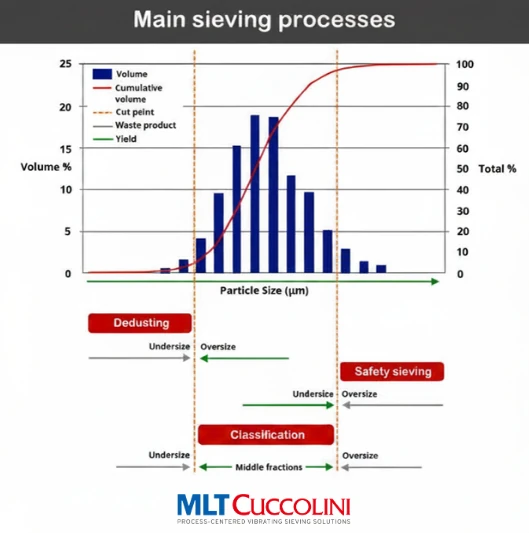
1. Clean a powder or granular material from unwanted undersized or oversized particles. This includes eliminating lumps, contaminants, insects, metal fragments, or excessive fine dust. These processes correspond to the applications of Safety or Control Sieving and Dedusting, respectively.
2. Separate a powder or granular material into different granulometric fractions to obtain multiple well-defined product groups. This step is associated with the application of Classification.
3. Extract solid particles from a suspension to recover valuable solids, reduce waste volume, or prepare a material for further filtration or drying stages. This application corresponds to Solid-Liquid Separation or Fluid Liquid Filtration.
4. Refine and soften a viscous liquid to eliminate residual solid impurities. The corresponding application is Purification or Viscous Liquid Filtration.
Why is sieving introduced in manufacturing processes?
Sieving is integrated into manufacturing for several reasons, including product quality, process efficiency, and sustainability goals. The most common drivers include:
1. Safety
Sieving is often required to ensure unwanted particles do not enter the production cycle together with the main product.
In industries such as food processing, this step is mandatory, as it ensures compliance with strict safety regulations. In other sectors, safety sieving plays a crucial role in protecting equipment, preventing contamination, and ensuring the quality of final components.
2. Quality and Product Differentiation
Sieving is also used to identify and create different product grades from a single bulk ingredient.
Particle size can significantly influence the performance or value of a product across many industries, such as food, metal powders, construction materials, plastics, and chemicals.
By separating a bulk material into specific size fractions, manufacturers can create distinct products suited for different applications or customer requirements.
3. Recovery and Sustainability
The growing emphasis on circular economy principles is pushing industries to rethink how they manage waste and by-products.
In this context, sieving provides an effective way to recover valuable material from waste streams, transforming it into a profitable product that would otherwise be discarded.
This contributes to both facilitating efficiency and environmental sustainability while generating new business opportunities.
Every sieving process requires ongoing attention to ensure that the highest performance is being achieved and maintained throughout the machine’s lifecycle.
The performance and durability of a vibrating sieve depend on two main variables: operation and installation correctness, and regular maintenance. When these factors are well controlled, the machine performs reliably; when they are not, efficiency drops and the risk of mechanical failure arises.
A vibrating sieve is a dynamic system, much like a violin string, which must be correctly tensioned and vibrated to produce a clean, stable sound. If the vibration changes or the string is stressed improperly, the sound quality deteriorates, and the string may eventually fail. Yet a violin never plays in isolation; its clarity depends on an equally well-tuned and in harmony orchestra.
In the same way, a production plant functions like an industrial orchestra. The vibrating sieve may be the lead violin, but its performance depends on the balance of every “instrument” around it (feeders, conveyors, dryers, filters, and any other satellite process units). This is why it is key to attentively oversee the sieve’s ecosystem and auxiliary equipment: just as the violin instantly reveals the slightest discord in the ensemble, the vibrating sieve quickly responds to minor process modifications. Keeping all variables tuned and synchronized allows you to achieve a stable, balanced coexistence among all components of your process, ensuring the entire industrial orchestra performs effectively and reliably.