When moulded parts are rejected due to dimensional, visual, or functional defects, they represent both a cost and an opportunity. By grinding these non-compliant parts, processors obtain a heterogeneous regrind composed of granules, smaller chips, and fine particles. Without proper classification, this mix can compromise feeding behaviour, melt homogeneity, and the performance of glass-filled or mineral-filled compounds when reintroduced into the process.
The classification step focuses on separating on-spec regrind granules from coarse fragments and, where necessary, from excessive fines. Coarse pieces that are too large for stable feeding can be identified and redirected to the mill for additional grinding, while fines that could alter rheology or cause dust issues can be reduced in the main stream. As a result, the recovered fraction shows a more consistent particle size distribution, improving its compatibility with existing dosing and compounding systems.
Vibrating sieving is particularly suitable for this application, as it provides robust handling of dense, sometimes angular plastic chips while delivering precise separation at the required mesh sizes. Key parameters include mesh size, throughput, and installation point, taking into account the type of polymer, the presence of fillers such as glass or minerals, and the intended reuse rate in the formulation. Proper configuration helps maintain both throughput and separation efficiency over time.

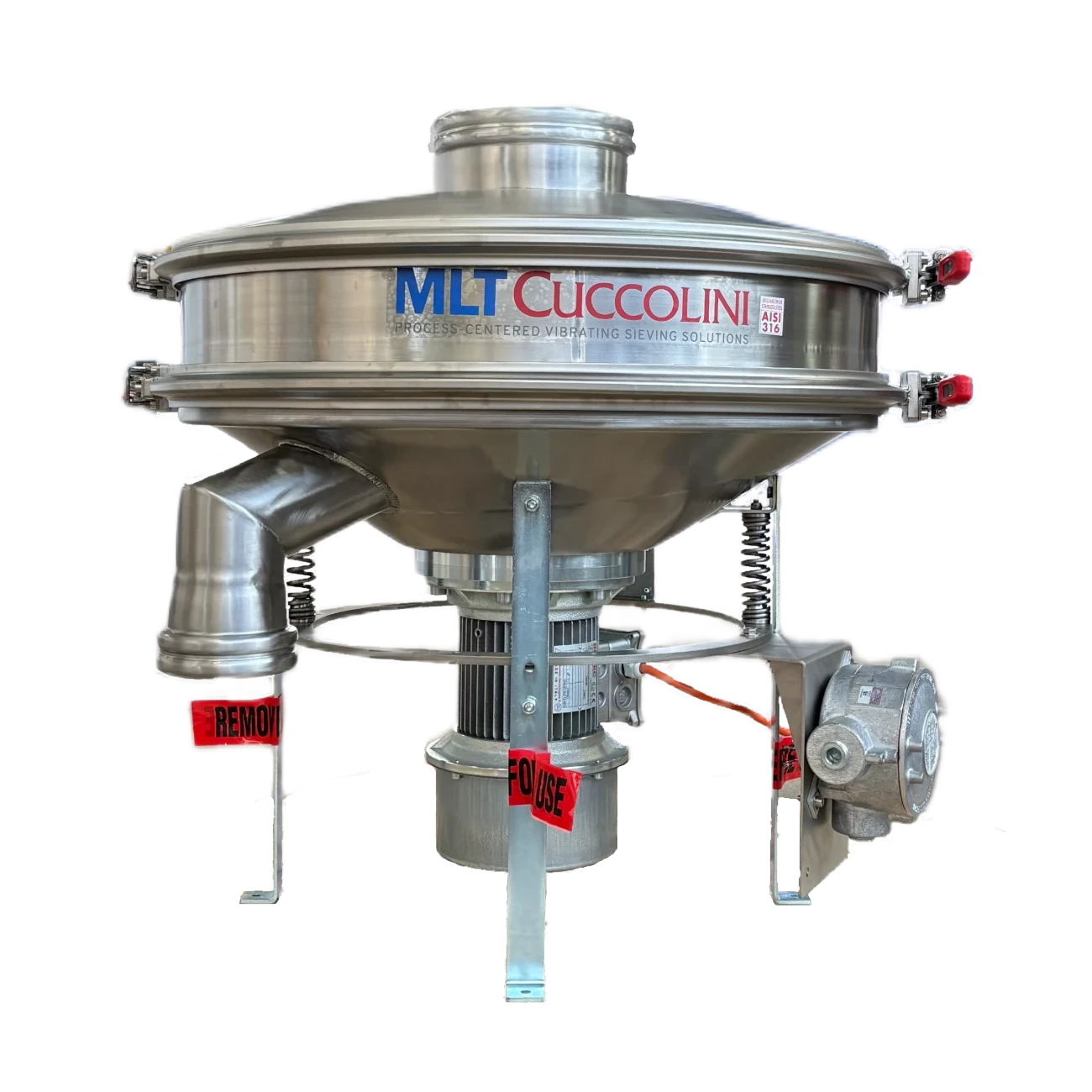
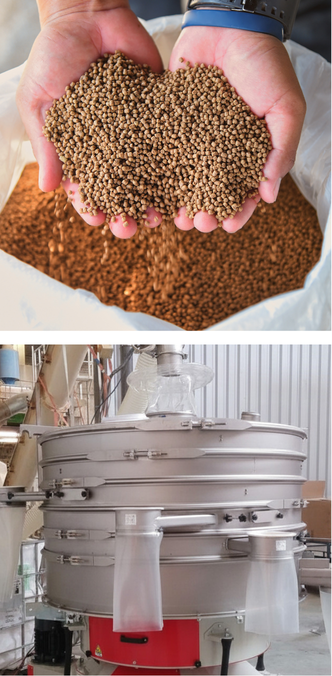
MLT Cuccolini VPB vibrating sieves are well suited for small to medium capacities or for decentralised regrind lines close to individual moulding machines. Typically installed directly downstream of the grinder, VPB units classify the ground material into on-spec granules and oversize fragments in a single pass. Their compact design and calibrated vibration support a stable cut point, enabling an efficient loop where oversize material is automatically returned to the mill.
For higher capacities or centralised grinding and recovery systems, VPM vibrating sieves offer increased throughput while maintaining the same level of classification accuracy. Installed under silos, above storage bins, or along conveying lines feeding mixing and compounding equipment, VPM machines ensure consistent regrind quality for larger production campaigns. Their robust construction is designed to withstand continuous operation and the mechanical stress associated with filled plastics.
Both VPB and VPM can be configured with multiple decks if additional fractions are required, for example to create a fine fraction that can be managed separately from the main regrind stream. Modular design, easy access for inspection and cleaning, and quick mesh changes support flexible production schedules and frequent recipe changes, which are common in plastics plants working with a wide variety of materials and products.
Using MLT Cuccolini VPB and VPM vibrating sieves for grinded plastic classification from non-compliant moulded objects supports higher recovery of valuable materials and more controlled reuse of regrind in production. By delivering a consistent, on-spec particle size distribution and removing coarse fragments for re-milling, these solutions help stabilise processing conditions, protect downstream equipment, and reduce waste.
The combination of precise classification, robust design, and flexible configuration makes these machines a practical choice for plastics processors aiming to enhance their internal recycling strategies and improve the overall sustainability of their operations.
Contact MLT Cuccolini to discuss your grinded plastic recovery process from non-compliant moulded objects and identify the most suitable VPB or VPM vibrating sieving configuration for your specific plastics recycling and production needs.