Classification is needed to create homogeneous fractions for different production purposes
Powders classification is the sieving process used to create homogeneous product fractions from a single bulk of powder or granules. Its main objective is to separate the material into one or more well‑defined size ranges, each of which can be used for different production purposes.
In many industries, from building materials and chemicals to food and metal powders, a single bulk product must be divided into several fractions with specific particle size distributions.
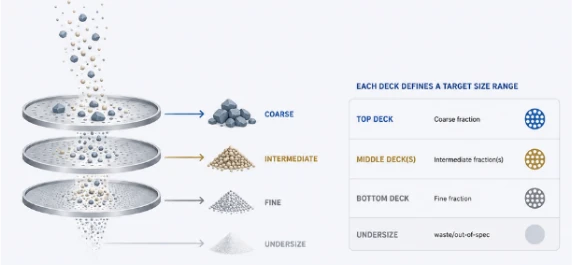
Classification achieves this by passing the material over one or more decks, each equipped with a mesh selected to define a target size range. The result is a set of fractions that can be directed to different recipes, applications or processing routes, while out‑of‑spec material can be recycled or treated separately.
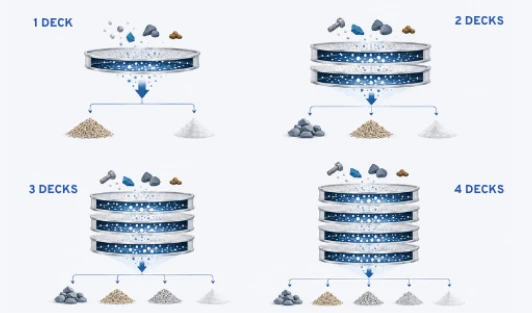
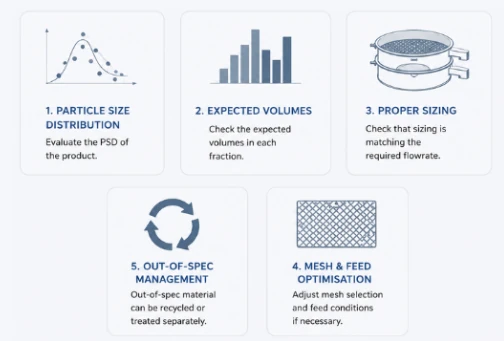
Depending on the required number of fractions, the sieving unit can be configured from one up to four decks in a single machine. For a correct classification setup, the particle size distribution of the product must be evaluated, the expected volumes in each fraction must be checked against the capacity of the decks, and any necessary corrections in mesh selection or feed conditions must be considered before finalising the configuration.
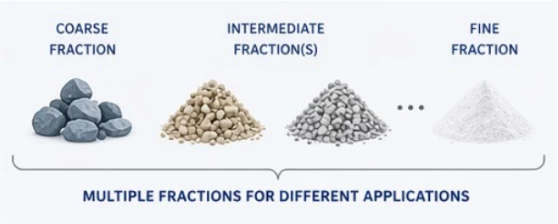
One product, multiple fractions
A single bulk product devided into several fractions with specific particle size distributions.
Flexible configuration
The sieving unit can be configured
from one up to four decks
How classification works
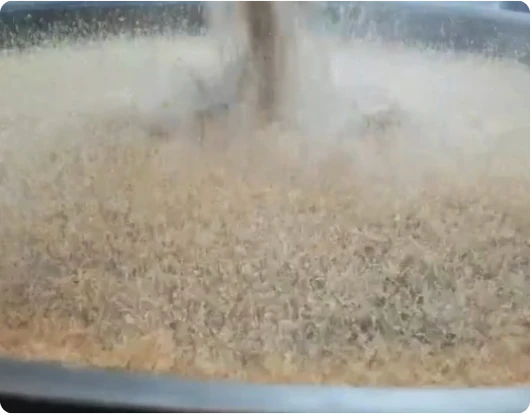
The bulk product is passed over one
or more deck with different mesh size.
The right classification set-up
Typical installation contexts
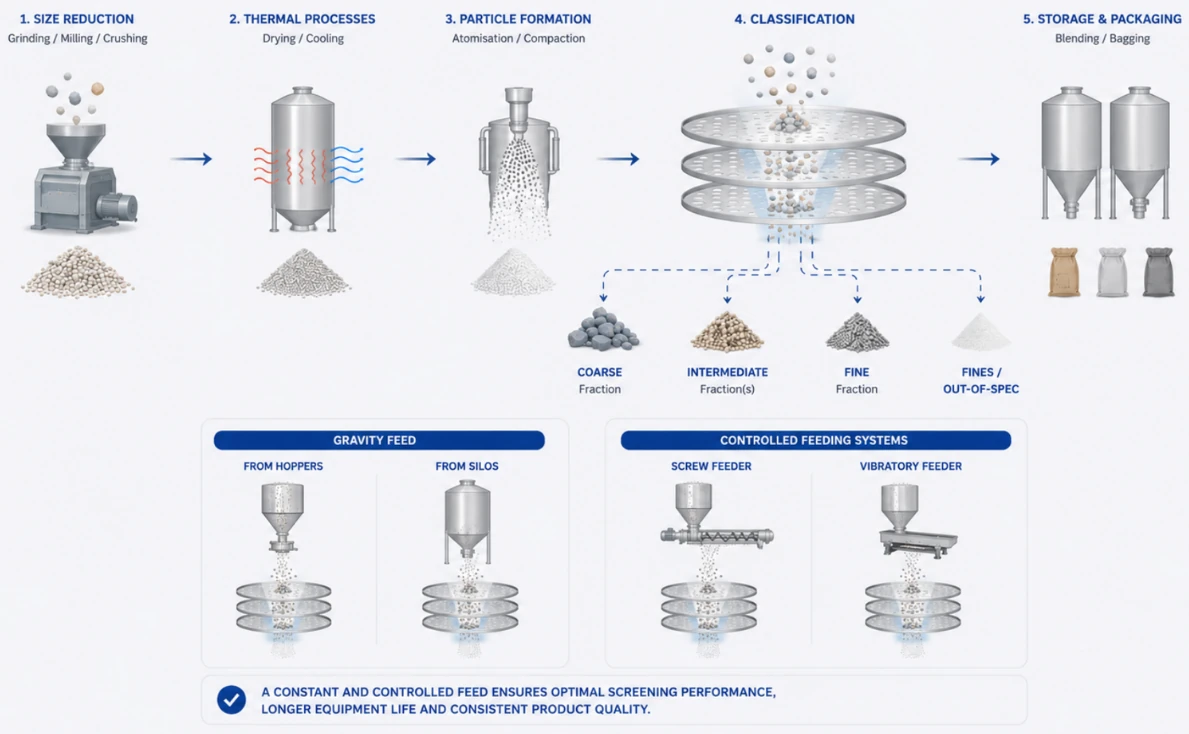
Powders classification is usually installed downstream of grinding, milling or crushing steps, where a broad particle size distribution is generated and needs to be separated into defined ranges. It can also be placed after drying, cooling, atomisation or compaction processes to remove fines or oversize particles and to produce market‑ready grades. In some cases, classification is integrated between intermediate storage and packaging, where different fractions of the same base product are bagged separately or combined into specific blends.
Depending on the process layout, sieves for classification can be gravity‑fed from hoppers and silos or integrated with controlled feeding systems, such as screw feeders or vibratory feeders, to ensure a constant and continuous product supply. This steady feed is essential to keep separation efficiency stable and to avoid overloading individual decks.
MLT Cuccolini’s safety sieving solutions
Our range includes machines specifically selected for safety and control sieving applications, offering reliable performance across different products, capacities and process requirements. Explore the solutions below and find the most suitable option for your production line.
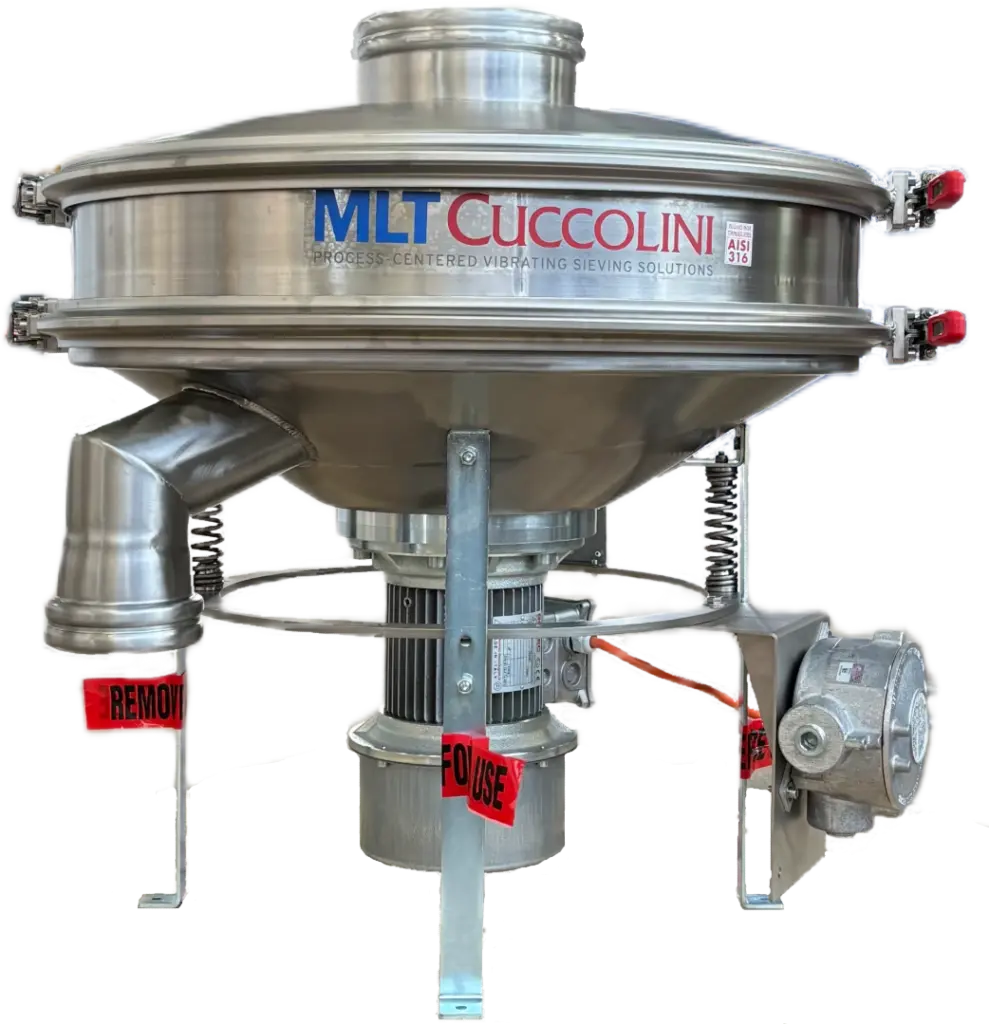
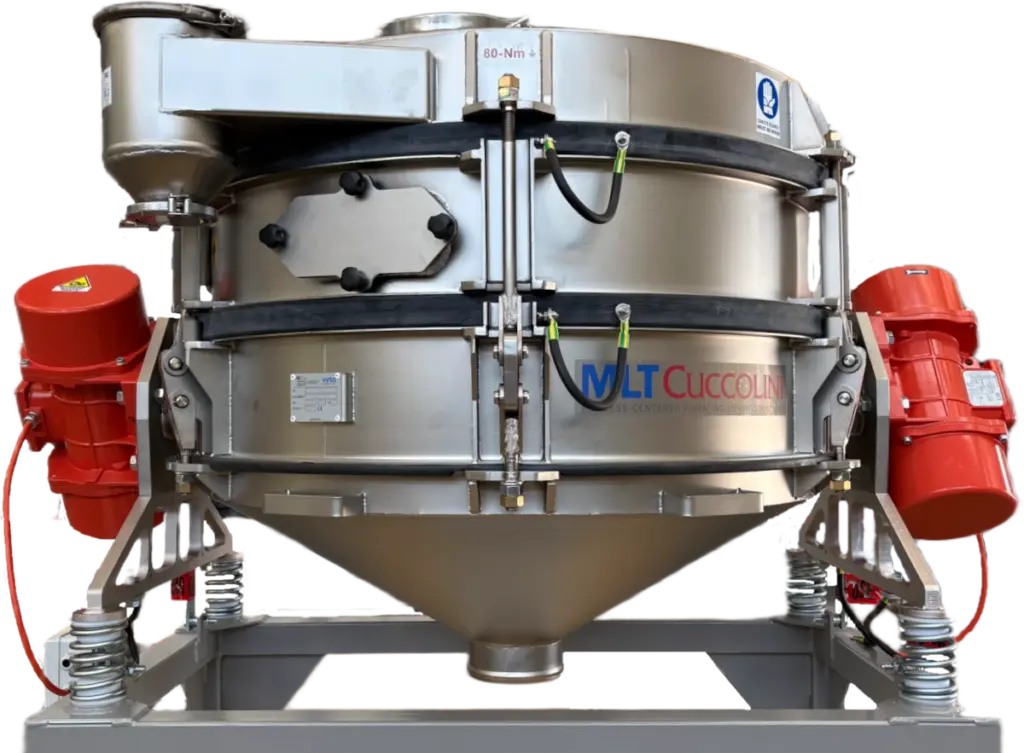
VPB/M
For many powder classification duties, MLT Cuccolini offers the VPB/M vibrating sieve range, which can be equipped with up to four decks in a single machine and typically handles flowrates up to around 10 t/h, depending on product characteristics and mesh apertures. VPB/M is suitable when multiple fractions are required at moderate capacity, combining compact design with the flexibility to adjust mesh sizes and vibration settings to the specific classification task.
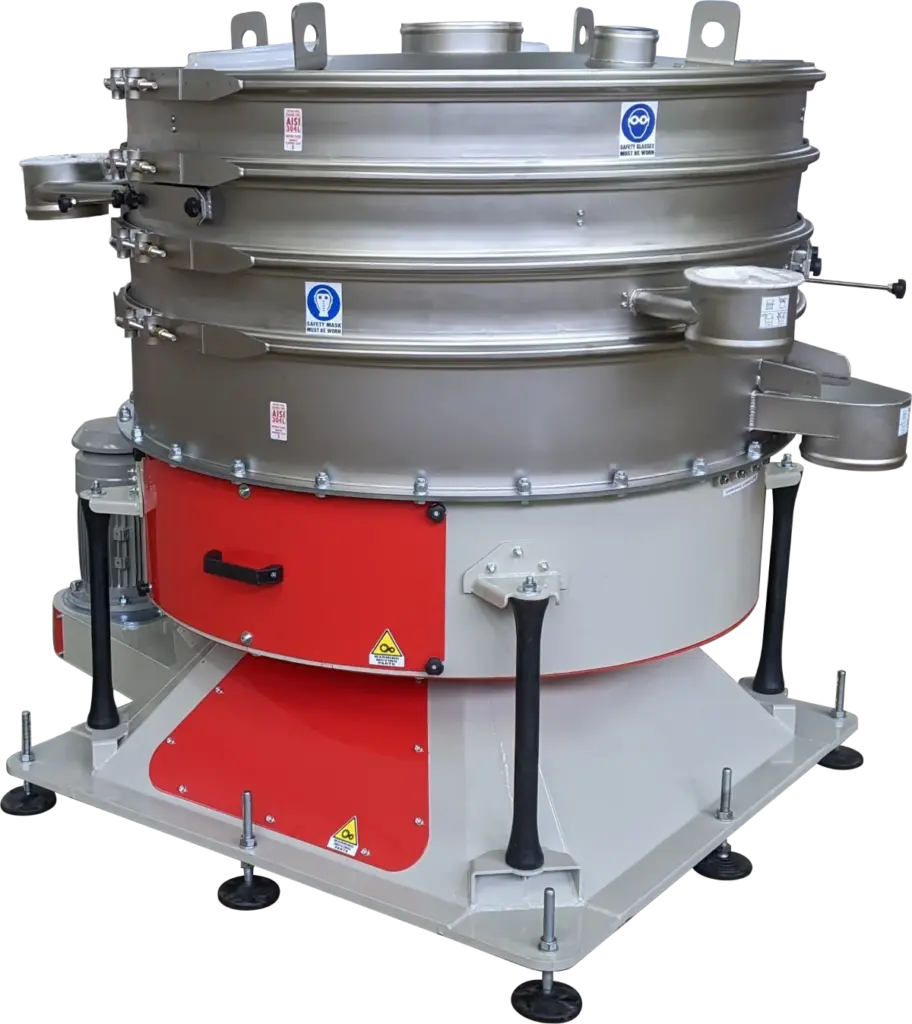
When higher capacities are needed, the VTU range can be applied, also with up to four decks and flowrates within approximately 50 t/h; for even larger throughputs, special configurations may be considered. VTU machines are particularly suited to bulk processing of building materials, some chemicals and other products where large volumes must be separated into several fractions without sacrificing cut accuracy.
For critical dry products that are difficult to screen—such as fatty, cohesive or hygroscopic powders—MLT Cuccolini proposes CS/CD multifrequency sieves. These machines can be configured with up to two decks and typical flowrates up to around 5 t/h, depending on product behaviour and mesh configuration. Multifrequency technology helps keep meshes active and reduces blinding, which is essential to maintain classification performance on challenging materials.
Since total applicable flowrate always depends on product characteristics, MLT Cuccolini operates a testing facility where physical trials can be run to evaluate the most suitable sieve type, number of decks and mesh configuration for each classification task.
In addition, we can provide support in the selection of appropriate feeding equipment, ensuring that product supply to the classifier is constant and continuous, so that the target separation efficiency can be achieved and maintained over time.
Explore our full range of sieving solutions, designed to support many other process applications across different production needs.
KEY BENEFITS OF POWDER AND GRANULES CLASSIFICATION WITH MLT CUCCOLINI SIEVES
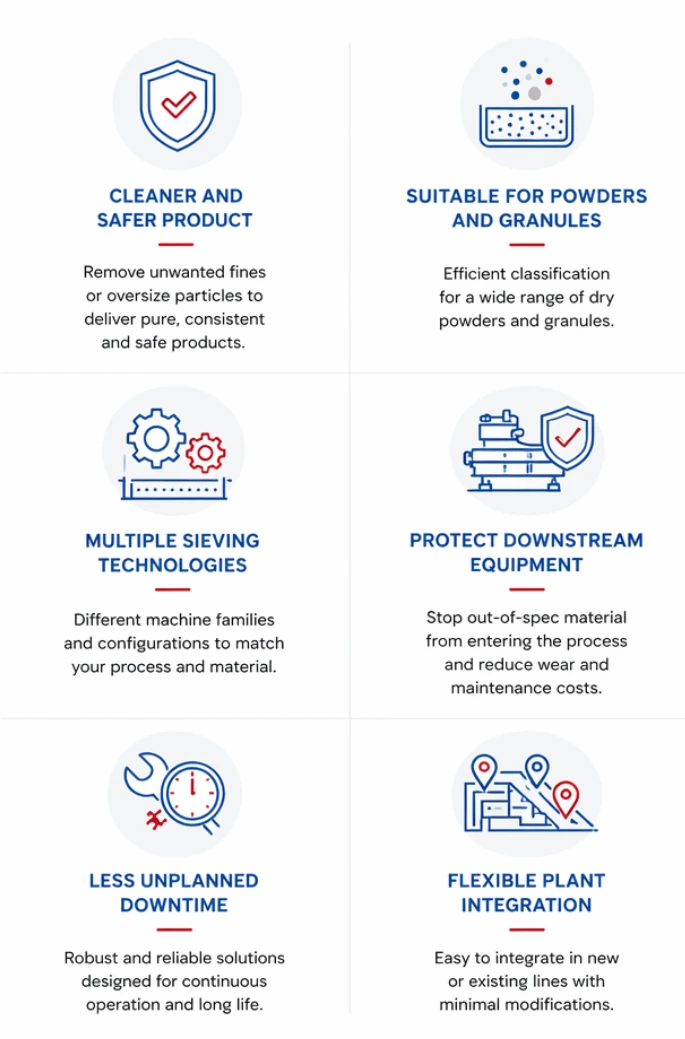
Performing powders classification with MLT Cuccolini equipment allows producers to obtain well‑defined fractions from a single bulk product, supporting the creation of multiple finished products or process streams while controlling particle size distribution.
The availability of different machine families—from VPB/M for standard duties to VTU for high‑capacity lines and CS/CD for critical powders—enables the classification step to be tailored to throughput, product behaviour and required number of fractions.
This leads to cleaner fractions, improved performance in downstream processes, reduced rework and better utilisation of raw materials. Support from MLT Cuccolini’s testing facility and application specialists helps process engineers and plant designers select the optimal combination of sieve type, deck configuration, mesh sizes and feeding system for each specific line.
KEY BENEFITS OF POWDER AND GRANULES CLASSIFICATION WITH MLT CUCCOLINI SIEVES
Performing powders classification with MLT Cuccolini equipment allows producers to obtain well‑defined fractions from a single bulk product, supporting the creation of multiple finished products or process streams while controlling particle size distribution.
The availability of different machine families—from VPB/M for standard duties to VTU for high‑capacity lines and CS/CD for critical powders—enables the classification step to be tailored to throughput, product behaviour and required number of fractions.
This leads to cleaner fractions, improved performance in downstream processes, reduced rework and better utilisation of raw materials. Support from MLT Cuccolini’s testing facility and application specialists helps process engineers and plant designers select the optimal combination of sieve type, deck configuration, mesh sizes and feeding system for each specific line.
KEY BENEFITS OF POWDER AND GRANULES CLASSIFICATION WITH MLT CUCCOLINI SIEVES
Performing powders classification with MLT Cuccolini equipment allows producers to obtain well‑defined fractions from a single bulk product, supporting the creation of multiple finished products or process streams while controlling particle size distribution.
The availability of different machine families—from VPB/M for standard duties to VTU for high‑capacity lines and CS/CD for critical powders—enables the classification step to be tailored to throughput, product behaviour and required number of fractions.
This leads to cleaner fractions, improved performance in downstream processes, reduced rework and better utilisation of raw materials. Support from MLT Cuccolini’s testing facility and application specialists helps process engineers and plant designers select the optimal combination of sieve type, deck configuration, mesh sizes and feeding system for each specific line.
Need support defining the right classification solution?
Let’s discuss your particle size requirements and process layout, Togheter, we will find the MLT Cuccolini classification solution best suited to your materials, throughput targets, and required number of fractions.