During plastic granules production and handling, a range of unwanted elements may enter the material stream. These include foreign bodies such as pieces of packaging, metal fragments, or other contaminants, as well as "angel hair" strands formed when molten polymer is stretched and solidifies as fine filaments. If not removed, these elements can cause blockages in feeding systems, irregular melting, filter clogging, and surface defects on the final parts.
Safety sieving focuses on intercepting these foreign bodies and irregular particles before the granules enter critical process stages such as drying, dosing, or the supply to extruders and injection moulding machines. The aim is not to modify the granulometry of the on-spec pellets, but to act as a final control barrier that ensures a clean, stable feed. This contributes directly to process reliability, reduction of downtime, and protection of downstream equipment.

Vibrating sieving is particularly suitable for plastic granules safety sieving, as it allows efficient separation at relatively coarse mesh sizes while handling significant throughputs. Key parameters such as mesh size, throughput, and installation point must be defined according to the type of polymer, the expected level of contamination, and the configuration of upstream and downstream equipment. Correct selection ensures that on-spec pellets pass freely while oversized contaminants and filamentous residues are retained.
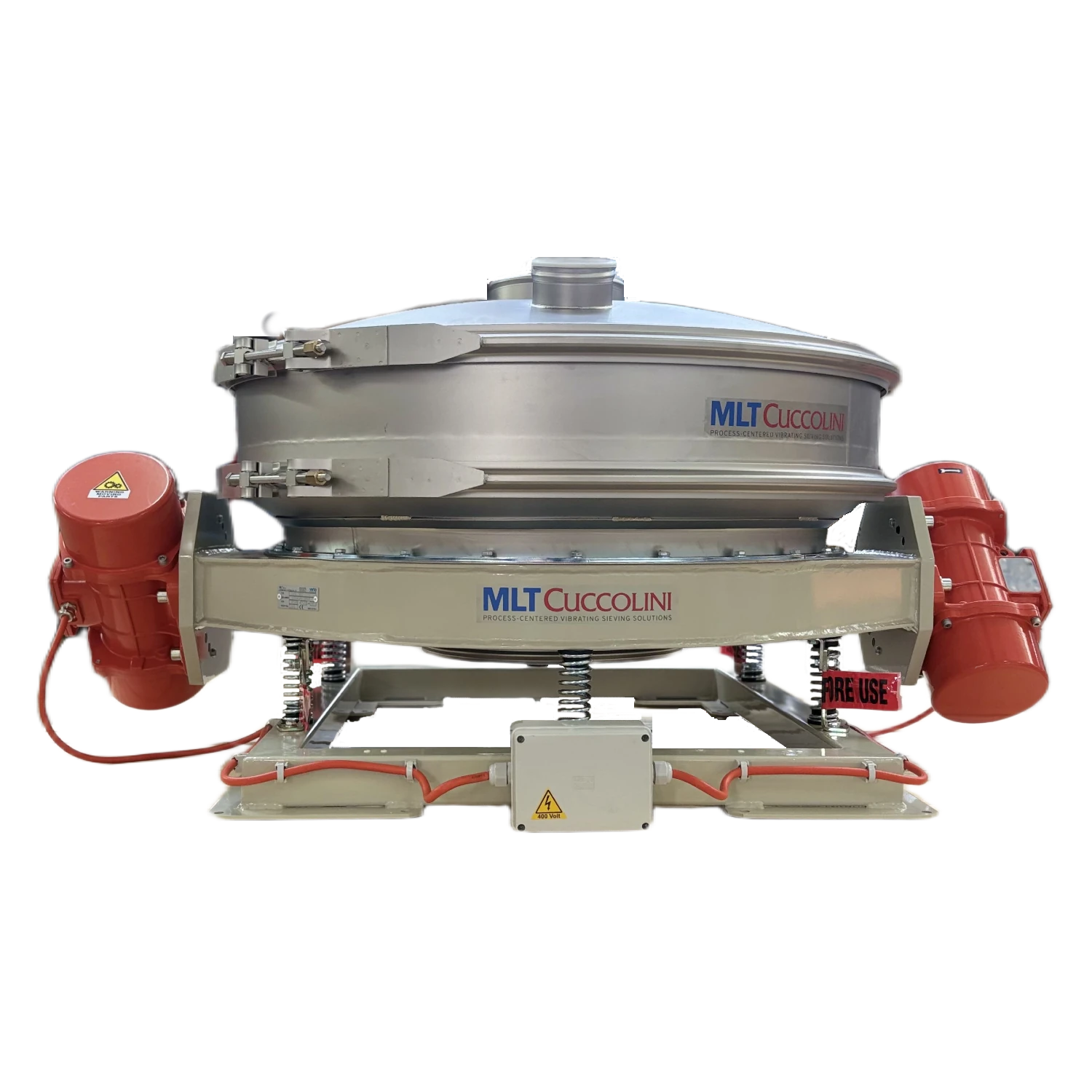
MLT Cuccolini VP2 circular vibrating sieves are an effective choice for this segment. Typically installed under silos, at sack tip stations, or along conveying lines feeding processing machines, VP2 units act as robust safety barriers that intercept undesired material. Their calibrated vibration and circular motion support a stable flow of pellets across the screening surface, ensuring efficient retention of foreign bodies and angel hair without compromising throughput.
The VP2 design combines a compact footprint with ease of integration into existing plants, making it suitable both for new installations and retrofits. Depending on process needs, it can operate in continuous or batch mode, handling a wide range of polymer types and pellet shapes. Options for different mesh sizes allow adaptation to various granule dimensions and contamination profiles.
Food-grade or high-spec executions, with stainless steel contact parts and appropriate surface finishes, can be supplied when required — for example, in applications involving plastics for food contact or other regulated uses. Easy access for inspection and cleaning supports regular maintenance and rapid screen changes, helping processors maintain high standards of hygiene and operational efficiency.
Using MLT Cuccolini VP2 vibrating sieves for plastic granules safety sieving helps ensure a clean and consistent feed to plastics processing equipment, improving process stability and final product quality. Effective removal of foreign bodies and angel hair protects downstream systems from blockages and wear, reducing unplanned downtime and maintenance interventions.
The combination of robust design, flexible configuration, and high-capacity handling makes VP2 a practical and dependable solution for a wide range of plastics processing plants seeking to enhance their safety sieving step.
Contact MLT Cuccolini to discuss your plastic granules safety sieving needs and identify the most suitable VP2 vibrating sieve configuration for your specific plastics processing line.