
granules
dedusting
Clean your product
from fine fragments or dust!
granules
dedusting
Clean your product
from fine fragments or dust!
Dedusting is needed if your granular product
requires cleaning from finer particles
During production, conveying and handling, many granular products generate fines through abrasion, breakage and friction. If these fines remain in the bulk, they can negatively affect flowability, dosing accuracy, appearance and, in some cases, dust emissions in downstream equipment. Dedusting addresses this issue by selectively removing the fine fraction while keeping the main granule fraction intact.
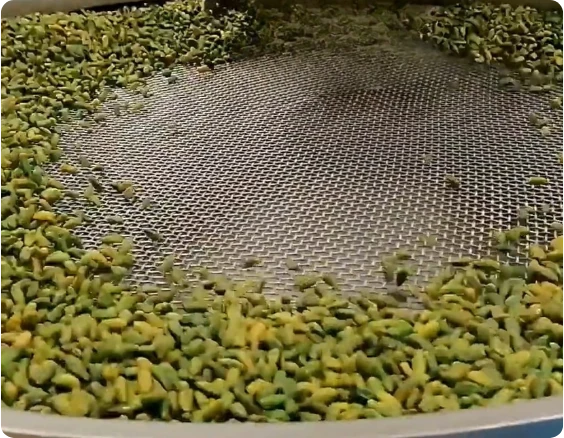
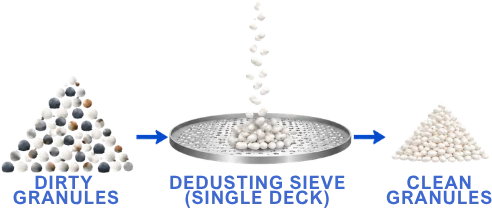
In dedusting, sieving usually takes place on a single deck, which separates the fine fraction from the bulk of the granules.
While an additional upper deck may be used in some cases to refine the process, the key point is that most of the product must pass through the oversize outlet of the dedusting deck, while fines are removed through the undersize outlet.
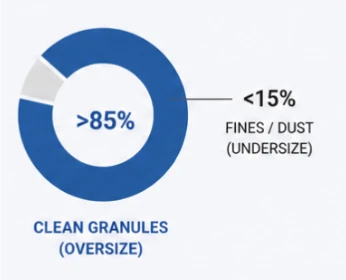
Because the fine fraction typically represents no more than about 15% of the total volume, the process requires a longer residence time for the main product on the screen than in a typical one‑deck classification step.

Process at a glance
Single-deck sieving removes fines and dust
from the main granule flow.
Safety Sieving Action
Most of the product remains on the screen longer
before exiting through oversize outlet.
Typical installation contexts
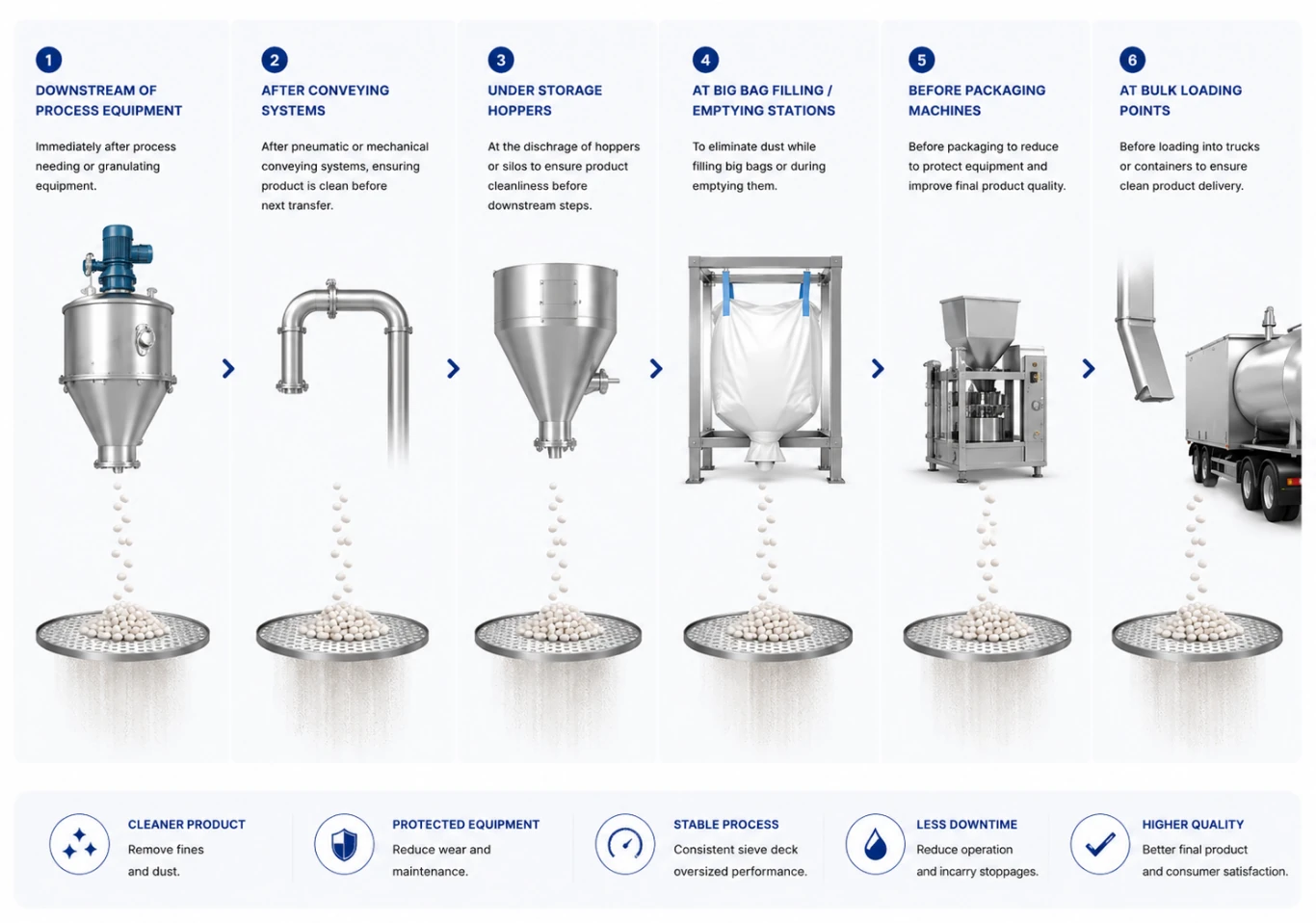
Granules dedusting is often installed downstream of reactors, granulators, dryers or coolers, where freshly produced granules contain residual dust that must be removed before storage or packaging. It can also be placed after conveying systems or handling steps that tend to break granules, such as pneumatic transfer, mechanical conveying or loading/unloading operations. In these positions, dedusting improves product cleanliness and reduces dust loads in filters and extraction systems.
Depending on the industry, dedusting units may be integrated under storage hoppers, at the discharge of big bag filling or emptying stations, or immediately before packaging machines or bulk loading points. In all cases, a constant and continuous feed to the sieve is essential, so that separation efficiency can reach and maintain the desired level. MLT Cuccolini can support users in selecting appropriate feeding equipment to ensure stable operation.

MLT Cuccolini’s safety sieving solutions
Our range includes machines specifically selected for safety and control sieving applications,
offering reliable performance across different products, capacities and process requirements.
Explore the solutions below and find the most suitable option for your production line.
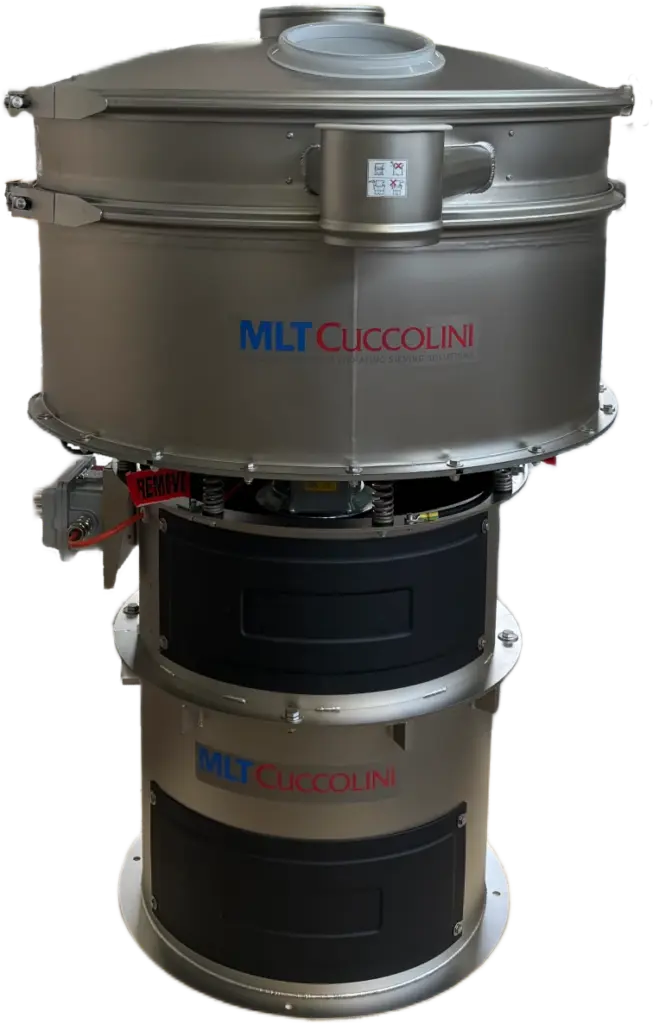
VPB/M
For many dedusting duties at moderate flowrates, MLT Cuccolini recommends VPB/M vibrating sieves with one deck. These machines typically handle flowrates up to around 3 t/h, depending on product characteristics, and are suitable when precise removal of fines and stable residence time on the screen are required. The vertical‑motor drive provides a controlled three‑dimensional motion that keeps granules moving while allowing fines to pass efficiently through the mesh.
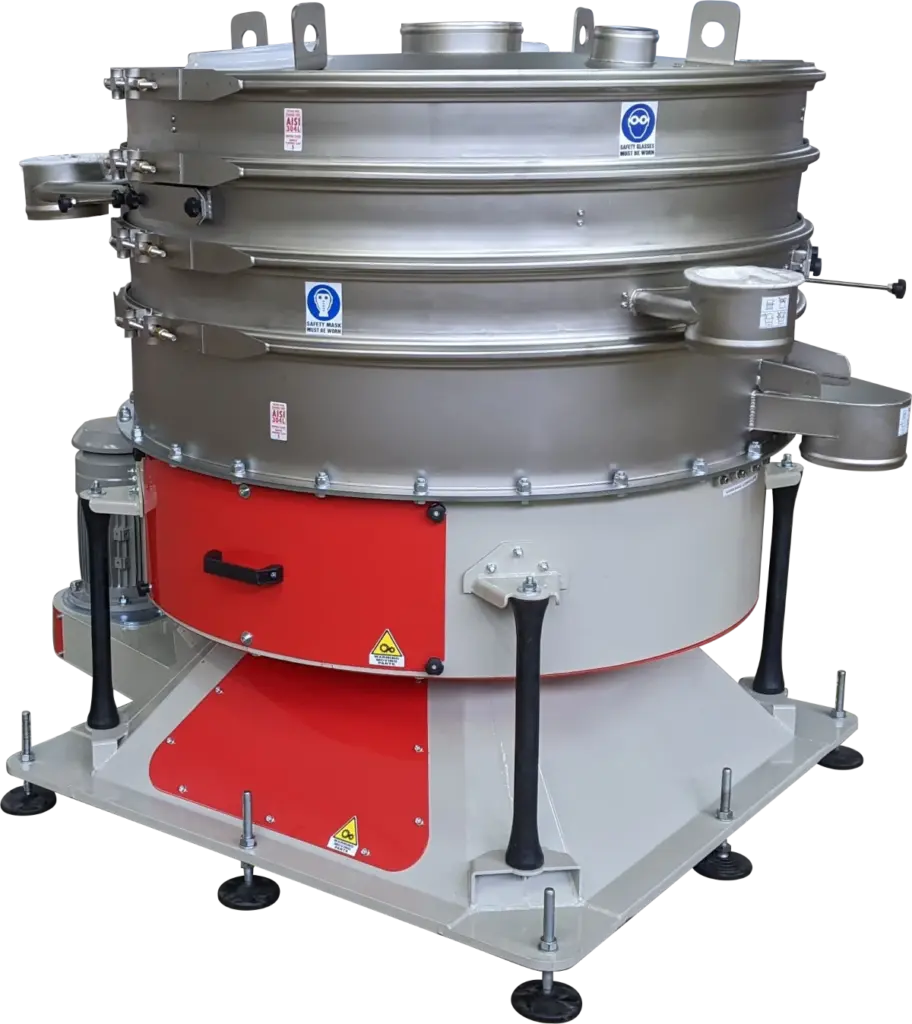
VTU
When higher capacities are needed, VTU single‑deck units can be applied, with typical flowrates up to around 5 t/h. VTU machines offer larger screening surfaces and an operating principle adapted to handle significant volumes of granules while still focusing on fines removal. They are particularly suited to recycling lines, coffee beans and similar applications where both dedusting effectiveness, product integrity and throughput are important.
In every case, total applicable flowrate depends strongly on product behaviour:
particle size distribution, friability, moisture content and dust generation tendencies.
To define the best solution, MLT Cuccolini operates a testing facility where physical trials can
be carried out, enabling verification of the dedusting efficiency and optimisation of sieve type,
mesh size and operating parameters for each specific material.
Explore our full range of sieving solutions, designed to support many other process
applications across different production needs.
KEY BENEFITS
OF GRANULES DEDUSTING
WITH MLT CUCCOLINI SIEVES
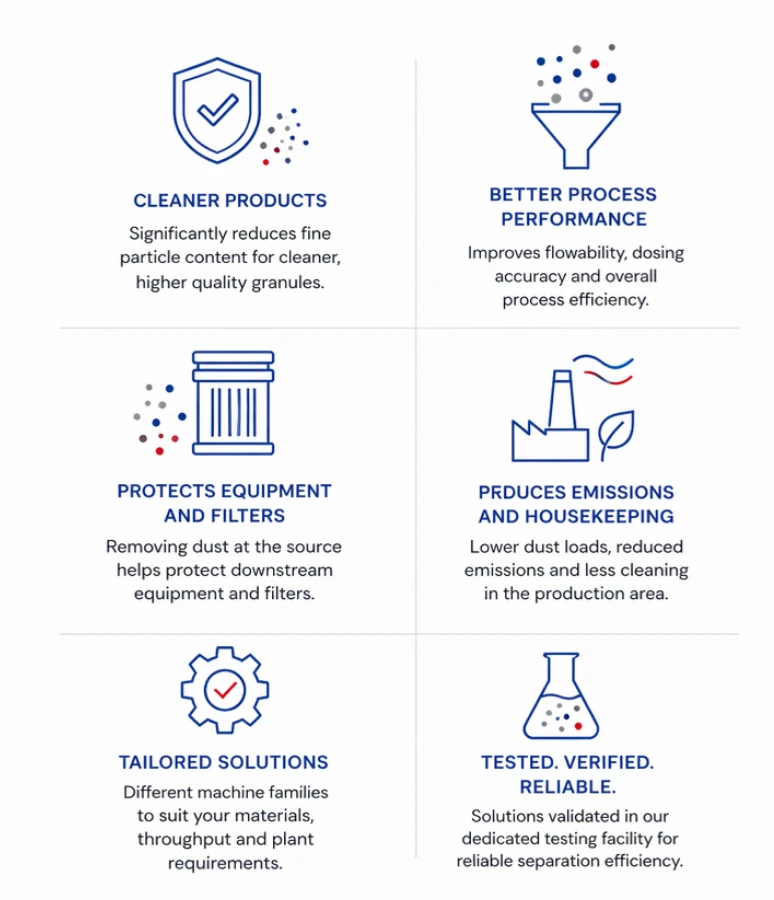
Using MLT Cuccolini equipment for granules dedusting provides cleaner products with significantly reduced fine particle content, improving flowability, dosing accuracy and visual quality. At the same time, removing dust at this stage helps protect downstream filters and equipment, reduce emissions and limit housekeeping needs in the production area.
Thanks to the availability of different machine families and the support of a dedicated testing facility, dedusting solutions can be tailored to process requirements, ensuring stable throughput, reliable separation efficiency and compatibility with a wide range of plant layouts and industries.
Are you looking to reduce dust and fine fragments in your granular products, from recycling streams to coffee, spices or chemicals? Contact our team to review your process and define the MLT Cuccolini dedusting solution best suited to your materials, throughput and installation constraints.
KEY BENEFITS
OF GRANULES DEDUSTING
WITH MLT CUCCOLINI SIEVES
Using MLT Cuccolini equipment for granules dedusting provides cleaner products with significantly reduced fine particle content, improving flowability, dosing accuracy and visual quality. At the same time, removing dust at this stage helps protect downstream filters and equipment, reduce emissions and limit housekeeping needs in the production area.
Thanks to the availability of different machine families and the support of a dedicated testing facility, dedusting solutions can be tailored to process requirements, ensuring stable throughput, reliable separation efficiency and compatibility with a wide range of plant layouts and industries.
Are you looking to reduce dust and fine fragments in your granular products, from recycling streams to coffee, spices or chemicals? Contact our team to review your process and define the MLT Cuccolini dedusting solution best suited to your materials, throughput and installation constraints.
KEY BENEFITS
OF GRANULES DEDUSTING
WITH MLT CUCCOLINI SIEVES
Using MLT Cuccolini equipment for granules dedusting provides cleaner products with significantly reduced fine particle content, improving flowability, dosing accuracy and visual quality. At the same time, removing dust at this stage helps protect downstream filters and equipment, reduce emissions and limit housekeeping needs in the production area.
Thanks to the availability of different machine families and the support of a dedicated testing facility, dedusting solutions can be tailored to process requirements, ensuring stable throughput, reliable separation efficiency and compatibility with a wide range of plant layouts and industries.
Are you looking to reduce dust and fine fragments in your granular products, from recycling streams to coffee, spices or chemicals? Contact our team to review your process and define the MLT Cuccolini dedusting solution best suited to your materials, throughput and installation constraints.
Need to reduce dust and fine fragments in your granular products?
Contact our team to review your process and define the MLT Cuccolini dedusting solution best
suited to your materials, throughput and installation constraints.