Many different types of circular vibrating screens are available on the market. You can find units with two opposing motors, with a vertical motor installed underneath the base of the screen, or with a single side motor.
Why such variety?
Each of these vibrator configurations generates a different type of vibration, and should be selected carefully based on the characteristics of the material to be screened and the separation process to be carried out – especially if we aim to achieve the highest possible efficiency in screening.
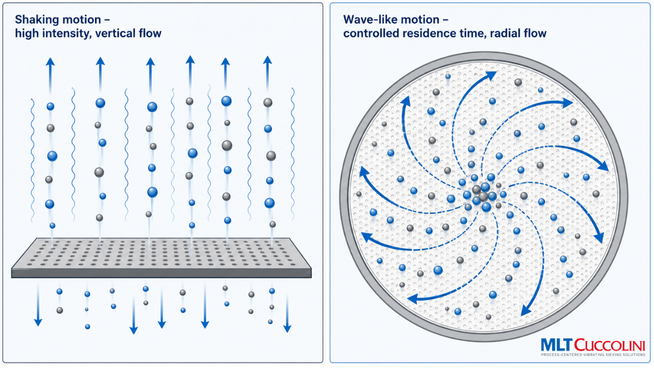
Back at school, we learned that vibrations can be distinguished into shaking motion and wave-like motion.
Shaking motion acts on bodies by making them bounce, essentially in place or with minimal displacement from their original position, creating high-amplitude, high-frequency vibration.
In industrial screening, this translates into high vibration intensity, which is typical of vibratory motors (a single one or two in opposition) positioned directly at the side of the screening mesh.
When we apply this concept to a circular vibrating screen, shaking motion works best when the screening meshes are relatively coarse.
Since there is no way to “force” the reaction of particles on the mesh, a particle bouncing under shaking motion can pass quickly through the mesh only if the opening size is much larger than the particle itself. This prevents the product from being retained on the mesh long enough to refine the separation and instead creates an almost vertical flow between the inlet and the outlet through the central discharge of the screen.
If, however, the mesh openings are close to the particle size – up to the point where the mesh aperture is less than 90–95% of the particle dimensions – shaking motion will allow very few particles to pass. The result is screen blinding, due to difficulty in evacuating particles; in the best-case scenario, the actual throughput will be very limited compared to the nominal size of the screen.
Shaking motion is therefore not the most versatile solution for every screening context.
It is instead very suitable for high-capacity safety screening within a mesh opening range that, at MLT Cuccolini, we have identified between 0.8 and 10 mm, with an oversize fraction (foreign particles to be rejected) not exceeding 3% – this is the case of our VP2 series.
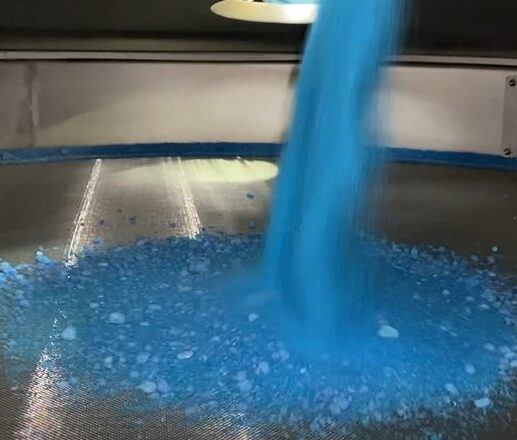
Wave-like motion, which is typical of a vertical motor installed at the bottom of the screen, creates a centrifugal, clockwise movement of the particles across the screening surface. This movement develops from the centre towards the periphery and finally along the vertical wall of the machine.
With wave-like motion – which can be adjusted to make the material path more or less direct across the mesh, thus speeding up or slowing down retention time – particles spread progressively over the mesh for as long as each needs to reach the correct position above or below the screen, according to its size. For this reason, the outlets of the screen are necessarily on the side, following the product flow as it builds up centrifugally.
This type of motion is the most suitable choice when we need to classify particles into two or more product fractions, while carefully considering how each material reacts based on its own characteristics (bulk density, particle shape, tendency to cake due to intrinsic or extrinsic moisture, tendency to generate electrostatics, etc.).
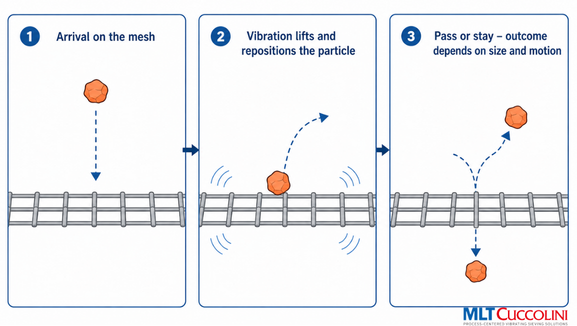
Wave-like motion is therefore the most versatile solution, because it can also be used for safety screening over a range from 0.007 mm (7 microns) up to 10 mm, at the expense of speed, which ultimately depends on each product.
There are, however, particularly critical materials that are not easily screened even with wave-like motion alone.
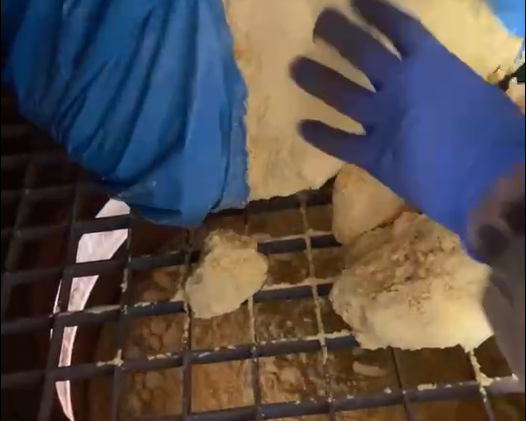
Typical cases include very fine products to be classified down to just a few microns; products with irregular particle shapes that tend to get wedged in the mesh apertures; products that form lumps
in reaction to the vibration transmitted by the mesh; products with very high specific weight requiring very intense vibrations; and many other formulations developed by industry for the most diverse purposes.
For these situations, MLT Cuccolini has developed – in cooperation with Kroosh Technologies – a solution that combines shaking and wave-like motion, opening up the vibration frequency spectrum from 0 to 100 Hz (compared to the 25–50 Hz usually generated by a standard vibrating screen) and allowing particles to “find” the right frequency to pass through the mesh.
This multifrequency screening technology, known as X-Line, makes it possible to handle difficult materials with the highest achievable screening efficiency.
Based on shaking motion generated by opposing side motors, an internal mechanism underneath the working mesh operates at high frequency, breaking the vertical product flow and imparting vibrations at various frequencies. This keeps the mesh clear while at the same time increasing the chances for particles to pass through according to their size, thus creating a wave-like motion that better controls particle movement on the mesh through a finely tuned mix of usable vibrations.
In conclusion, each screening process can be handled by a vibrating screen model tailored to the specific context and to the desired results. This is why it is essential to carefully assess what different manufacturers propose in relation to your real needs.
The extensive MLT Cuccolini range – among the broadest on the market – is ready to meet your screening requirements with the most suitable solution.