The quality of separation does not depend only on the screener itself, but also on how the product reaches the mesh. When the feed is irregular, excessive or mechanically disturbed, even a correctly sized machine can lose efficiency, retain a portion of fines in the oversize fraction and produce a less clean classification than expected.
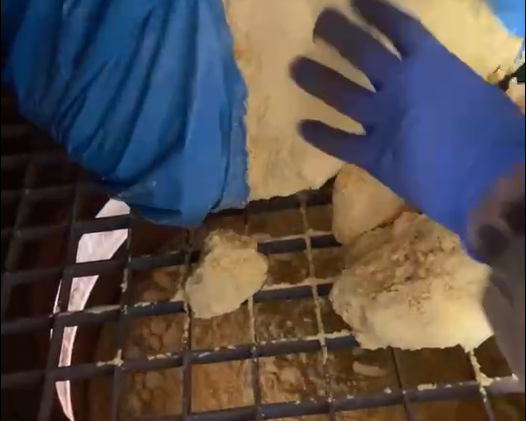
In the case analysed here, the product is scooped up from the floor and manually loaded with a shovel onto an open-top screener, that is, without a cover and without any system that keeps the feed rate constant. This approach has two combined effects: on the one hand, there is no real control over the amount of material fed to the mesh; on the other hand, each shovelful interferes with the vibratory motion and alters the conditions required for proper bed stratification.
The Problem: Irregular Feeding and an Excessively Deep Bed
When material reaches the mesh intermittently and in excessive quantities, the screen is forced to work with a bed that is too deep. Under these conditions, fine particles struggle to reach the screening surface and pass through the apertures, especially when the mesh is very fine and the process requires high separation sensitivity.
On a 100-micron mesh, a bed of just a few centimetres already represents a critical condition, because it increases the time needed for separation and reduces the likelihood that the finest fractions will quickly find a free passage. In practical terms, this is a well-known result in many screening processes: part of the undersize remains trapped in the material above it and is carried towards the coarse discharge, lowering yield and reducing the purity of the granulometric classes obtained.
Manual feeding with a shovel – but also with a scoop or any similar tool, even if everything were kept to limited quantities – does not only introduce variability in feed rate; it also introduces uncontrolled mechanical energy onto the screening deck. Every load thrown or dumped onto the mesh locally changes how the product is distributed, creates temporary build-ups and can disturb the normal vibrational behaviour of the bed, which instead should remain as uniform and continuous as possible.
On an open-top screener this effect is even more evident, because the operator interacts directly with the process area. If material is deposited in successive shovelfuls, the screener no longer operates within a stable feeding window, but continually swings from overload peaks to moments of relative emptying, with a dynamic that penalises fine separation and makes the result less repeatable.
Why Fine Powder Ends Up in the Wrong Fraction
Screening efficiency largely depends on the material’s ability to build up and behave correctly on the screening deck: finer particles must be able to migrate downwards until they come into contact with the mesh, while coarser particles remain on top and are conveyed to their respective outlet.
When the feed is too heavy or irregular, fine particles remain dispersed throughout the depth of the bed, do not reach the mesh surface frequently enough and can therefore leave the screener together with the oversize fraction, even though by size they should have passed through.
This is exactly what can be observed when a significant amount of fine powder is present in the oversize outlet, even though under correct conditions it should have ended up in the undersize fraction. In other words, the problem does not necessarily lie in the mesh itself, but in the operating conditions that prevent the screen from working within its optimal efficiency range.
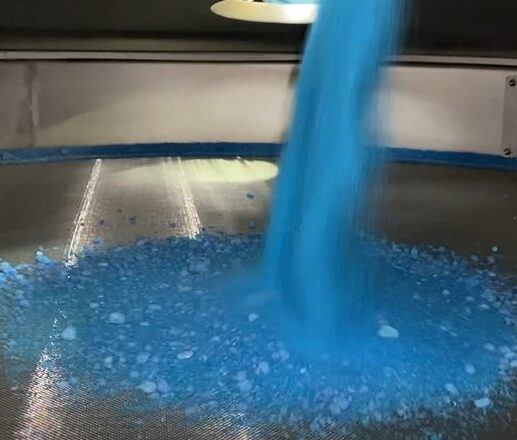
The technical value of a video comparison between incorrect and correct feeding is very high, because it makes an often-overlooked principle immediately visible: a screener separates properly only if the product is presented to the mesh in a controlled way. When the feed rate is regular and the material is distributed consistently with the machine’s capacity, the bed remains thinner, stratification improves and fine particles have a higher probability of passing through the mesh apertures.
In the test correctly carried out with zinc oxide, the greater amount of undersize recovered shows that some fines, initially adhering to or associated with coarser particles, have been able to separate more effectively. This results in a cleaner product in every particle size range and in a classification that is more useful downstream, both in terms of quality and in terms of the commercial value of the material obtained.
Zinc oxide is a particularly interesting material because its industrial performance is also influenced by particle size and powder fineness. The particle size of zinc oxide specifically affects properties such as reactivity, functional behaviour and suitability for certain industrial applications.
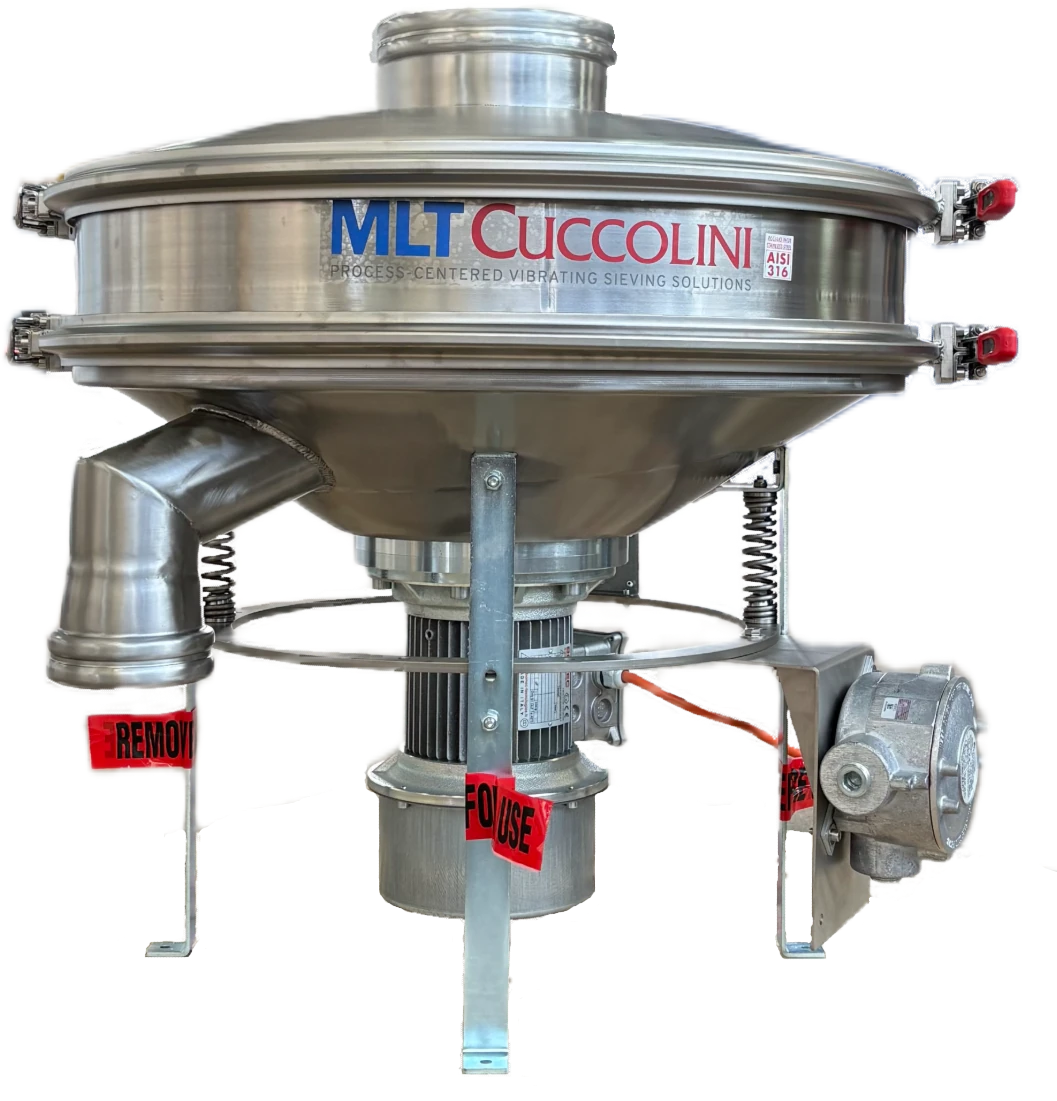 Zinc oxide is used in manufacturing processes and formulations in many different sectors, confirming that managing granulometric quality can have real effects on the final result of the process or of the compound in which the material is used.
For this reason, assessing how correct feeding improves separation does not only mean talking about screener efficiency. It also means highlighting how better classification can help obtain purer fractions that are more consistent with the product’s application requirements.
Ultimately, the quality of the final product improves and, in some cases, this improvement can easily pay back the investment in a suitable screening system thanks to the higher market value of the final product.
What This Case Teaches
This case shows that apparent productivity does not always match actual yield. Loading material quickly and without control may seem like an efficient operational choice, but if a significant share of fines ends up in the wrong fraction, the process loses value, internal contamination of the different classes increases and separation quality deteriorates.
Feeding must therefore be considered an integral part of the screening process, not just an accessory gesture. Constant feed rate, uniform product distribution and the absence of direct mechanical interference on the mesh are essential conditions to truly exploit the machine’s potential, especially when working with fine powders and 100-micron meshes.